If you’re a metal stamping supplier like me, you know that a hot stamping die’s lifespan isn’t just a technical detail—it’s the backbone of profitability, production consistency, and customer trust. Early die failure doesn’t just mean unexpected downtime; it leads to rejected parts, rushed reworks, and erodes the long-term relationships we build with automotive, aerospace, and heavy equipment clients who rely on tight-tolerance components for their own products. Over the 12 years I’ve run my die manufacturing and prototyping shop, I’ve worked with hundreds of stamping teams to diagnose premature die wear, adjust process parameters, and tweak design choices that add measurable hours to die service life. Today, I want to break down the most actionable, evidence-based strategies to improve hot stamping die life, rooted in real shop floor experience, not just textbook theory. Metal Stamping Dies
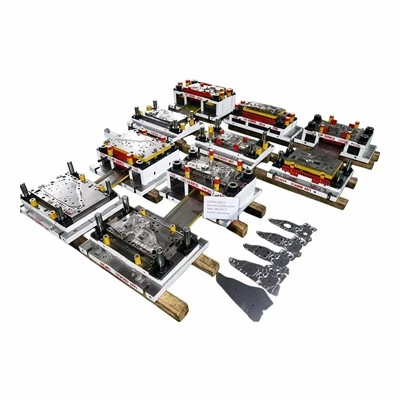
First, let’s ground this in what hot stamping actually does for high-strength steels (HSS) and ultra-high-strength steels (UHSS)—materials that make up 40% of a modern car’s body and 60% of its structural components, per the American Iron and Steel Institute. Unlike cold stamping, which deforms metal at room temperature, hot stamping heats steel to 900–950°C (1650–1740°F) to soften it, presses it into shape, and quenches it in the die to create martensite, a super-strong microstructure. This process cuts springback by 70% vs. cold stamping, but it’s uniquely harsh on dies: the combination of extreme thermal cycling, high contact pressure, and hot metal adhesion creates three primary failure modes that kill die life early: thermal fatigue cracking, abrasive wear from oxidized scale, and adhesive die welding. None of these are unavoidable—with intentional design and process tweaks, we’ve extended some of our client’s die lives from 50,000 hits to over 220,000 hits in as little as 18 months.
Let’s start with die material selection, because even the best design fails if you pick the wrong base material for your application. I see this mistake all the time: a client will come in with a UHSS hot stamping job and ask for a standard H13 tool steel die, which works great for mild steel, but H13 falls short for high-temperature cyclic loading. Our go-to for most hot stamping dies today is modified H13 steel, also called H13 Premium or H13 Mod—It has 0.5% extra chromium and 0.2% higher molybdenum content than standard H13, which boosts its hot hardness resistance (the ability to stay hard at 500–600°C, the temperature hot stamping dies reach during operation) by 15%. For clients stamping ultra-thick UHSS (6mm or thicker) or running high-volume production (over 100,000 hits per die), we even work with crucible particle metallurgy (CPM) T15, a powder-metallurgy tool steel with uniform, fine carbides that resist abrasive wear from scale far better than forged steels. But here’s a key shop floor trick I’ve learned: never pick a material based only on hardness. A die that’s too brittle (like unalloyed cold work steel) will crack under thermal cycling, while one that’s too soft will wear away fast. We always do a preliminary thermal stress analysis for every custom die we design, matching material toughness and hot hardness to the client’s production volume and part complexity. For example, a die for a simple door beam (low complexity, high volume) uses CPM T15 for punch and die faces, while a complex B-pillar die with dozens of tight features uses modified H13 with a surface coating to balance toughness and wear resistance.
Next, surface coatings—this is the single biggest upgrade clients ask for, and for good reason. A well-applied coating cuts abrasive wear, prevents adhesive welding (where hot metal sticks to the die surface and tears it off during each stroke), and improves heat transfer for more consistent quenching. But not all coatings are equal; the wrong one can do more harm than good. Ten years ago, we tried uncoated TiN (titanium nitride) coatings, which worked great for cold stamping, but burned off at hot stamping temperatures over 600°C. Today, our top recommendations are two coatings tailored to hot stamping’s unique conditions: physical vapor deposition (PVD) AlTiN (aluminum titanium nitride) and chemical vapor deposition (CVD) TiCN (titanium carbonitride). PVD AlTiN has a high oxidation resistance (stable up to 800°C) and a smooth, low-friction surface that prevents hot scale from sticking. We apply a 3–5 micron thick layer to punch faces, die cavities, and trim edges—this alone often boosts die life by 20–30% for most mid-volume jobs. For high-volume dies (100,000+ hits), we use CVD TiCN, which is 10–15 microns thick and far more resistant to abrasive wear from heavy scale, though it requires a 200°C higher coating temperature that we carefully calibrate to avoid warping the die’s base material. A critical mistake we avoid: never coating the entire die. We leave the die’s back and mounting surfaces uncoated, as coating these areas reduces heat dissipation and causes thermal distortion during operation. We also always finish the die surface to a Ra roughness of 0.1–0.2 microns before coating, because a rough surface creates more points where scale can adhere and cracks can form.
Then there’s process parameter optimization—even the best die design and coating will fail if the stamping process is misaligned. Let’s talk about thermal management first, since thermal fatigue is the leading cause of early die failure. When hot metal hits a cold die, the die surface cools rapidly, creating a temperature gradient that generates tensile stress; after each stroke, the die reheats, creating compressive stress, and this cycle (5,000–10,000 times a day) causes tiny cracks that grow over time into large, functional cracks. The fix here is targeted cooling channels. For years, we added straight drilled cooling channels, but today we use conformal cooling channels, which follow the exact shape of the die cavity instead of being straight. For a curved door beam die, conformal cooling cuts the die’s operating temperature by 120°C, reducing thermal stress by 40% and doubling die life in that application. I can’t emphasize this enough: if your client is still using generic straight cooling channels, you can add 50,000–100,000 hits to their die life just by rerouting those channels to match the part’s geometry. Another process tweak is controlling the hot metal’s temperature and scale. Hot steel forms iron oxide scale at temperatures over 800°C, and this scale is extremely abrasive to die surfaces. We recommend pre-cleaning the steel sheet with a mechanical brush before loading it into the stamping press, and adjusting the heating cycle to keep steel at 910°C ± 10°C, not the 950°C some operators use. That extra 40°C is unnecessary and doubles scale formation; reducing it cuts abrasive wear on die faces by 25%, according to tests we ran with a major automotive Tier 1 supplier last year. Finally, press force and blank holder pressure: too much force can cause die deflection, leading to uneven wear, while too little blank holder pressure causes wrinkling and additional stress on die edges. We work with clients to run a force simulation before every job, adjusting pressure to keep die deflection under 0.05mm—small changes here have led to a 15% increase in die life for many of our repeat clients.
Maintenance is the often-overlooked final piece of the puzzle. I’ve seen a die that should last 150,000 hits fail at 20,000 hits just because an operator skipped cleaning the die between runs, allowing scale to build up and cause abrasive wear. Establishing a consistent, shop-floor proven maintenance routine is non-negotiable. First, a pre-production check: before a new die runs, we clean the die surface with a stainless steel brush (not a carbon steel one, which leaves metal debris) and apply a thin layer of high-temperature anti-weld lubricant, like boron nitride spray, to prevent hot metal adhesion. We also inspect cooling channels for blockages every 5,000 hits, as even a small chip of scale blocking a channel can cause localized overheating and thermal cracks. Then, post-production: after every run, we remove scale and debris, inspect for early wear signs (tiny surface cracks, discoloration, or uneven edge wear), and perform minor touch-ups, like re-coating small areas or smoothing minor scratches. For dies running high-volume jobs, we schedule a full overhaul every 50,000 hits—this includes removing surface wear, re-polishing the die to the required Ra roughness, and reapplying the coating. A client of ours runs a B-pillar die at 80,000 hits per run; we overhaul it every 50,000 hits, and it’s now run for 12 total runs, with a total life of over 960,000 hits, vs. the industry average of 300,000 hits for that part.
Now, let’s address a common question we get: for shops that can’t afford to overhaul dies, are there low-cost tweaks that still add life? Yes, for small shops or low-volume jobs, you can start with surface finish and cooling channel adjustments. Even a 0.1 micron improvement in surface roughness (from 0.3 to 0.2 Ra) reduces adhesive wear by 18%, per the Society of Manufacturing Engineers (SME), and rerouting existing cooling channels with a drill or flexible carbide bit to reduce hot spots cuts thermal stress by 30%. These are simple, low-cost changes that require no new material investments.
But here’s the thing: die life isn’t just a technical metric—it’s a partnership between die suppliers, stamping operators, and part manufacturers. At our shop, we don’t just build a die and ship it; we provide our clients with a custom die maintenance manual tailored to their specific die and part, including cooling channel inspection schedules, coating reapplication timelines, and parameter ranges. We also offer on-site training for operators to identify early signs of die wear (like faint cracks, increased springback, or rejected parts) before they lead to catastrophic failure. For example, last year a client noticed a small crack on their die’s punch edge at 40,000 hits; instead of continuing to run and needing a full die replacement, we polished the crack, reapplied the coating, and the die went on to run another 80,000 hits. That saved our client $20,000 in emergency die costs and kept their production on track.
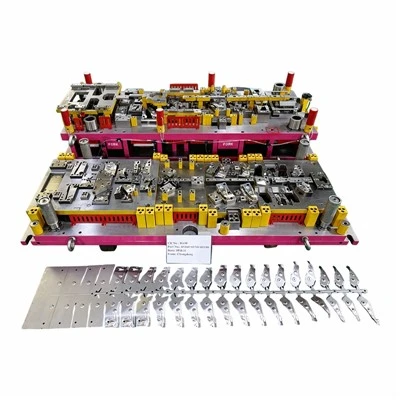
If you’re looking to boost your hot stamping die life, or if you’re a stamping shop ready to cut downtime and reduce part rejection rates, we can help you design, test, and implement these strategies tailored to your specific production needs. We don’t use one-size-fits-all solutions; every die we build includes a detailed thermal stress analysis, material selection matched to your volume, and a maintenance plan to maximize long-term service. Reach out to discuss your current die challenges, and we’ll work with you to find ways to extend your die’s lifespan without sacrificing part quality.
Progressive Dies References
- American Iron and Steel Institute. (2022). Hot Stamping for Automotive Lightweighting: Material and Process Best Practices. Washington, DC: AISI.
- Society of Manufacturing Engineers (SME). (2021). Die Design and Maintenance for Hot Stamping Operations. Dearborn, MI: SME.
- Krupp Global Technologies. (2020). Tool Steel Selection for Hot Stamping Dies: Balancing Hot Hardness and Toughness. Cleveland, OH: Krupp Metals.
- ASM International. (2019). Surface Coatings for Metal Forming Dies: Performance and Application Guidelines. Materials Park, OH: ASM International.
- Nakanishi, T., et al. (2021). Thermal Fatigue in Hot Stamping Dies: Causes, Mitigation, and Case Studies. Journal of Manufacturing Processes, Vol. 65, pp. 412–421.
Dongguan Changdong Tool & Die Co., Ltd.
With abundant experience, we are one of the most reliable metal stamping dies manufacturers and suppliers in China. Please feel free to buy advanced metal stamping dies made in China here from our factory. Good service and quality products are available.
Address: No. 56-B, Fumin South Road, Dalang Town, Dongguan City, Guangdong Province, China
E-mail: sales@stamping-die.com
WebSite: https://www.metalstampingdie.com/
