If you’ve ever driven past a gas station, you know those bright, flashing price signs are hard to miss. But if you’re a station owner or operator, you’ve probably also wondered: how much do these signs cost to run, and is there a way to make them more energy-efficient? As someone who’s been in the LED gas price sign supply business for over a decade, I get this question all the time—so let’s break it down straight, no confusing jargon, just the facts. LED Gas Price Sign
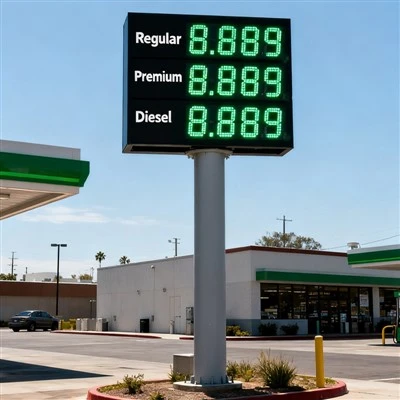
First, let’s clear up a common misconception: not all LED gas price signs are created equal. Back in the day, most gas station signs used neon or incandescent bulbs, which ate through electricity like nothing else. A typical neon sign might use 100 to 200 watts per side, and if you’ve ever gotten an electric bill, you know that adds up fast, especially when you’re running 24/7, 365 days a year. But when LED technology became mainstream in the early 2010s, that changed. Wait, but even then, early LED signs weren’t all as efficient as they could be. Some cut corners on the quality of the LEDs or the circuitry, so they still used more power than necessary. That’s where our work comes in.
Let me walk you through the basics of LED efficiency first. LEDs (Light Emitting Diodes) work by passing electricity through a semiconductor, which emits light instead of wasting energy as heat—unlike incandescent bulbs, which turn 90% of their energy into heat, only 10% into light. That’s a huge difference, but efficiency varies. A high-quality LED will have a lumen per watt (lm/W) rating that tells you how much light you get per unit of power. For context, a good general-purpose LED bulb is around 100 lm/W, but the LEDs we use in our gas price signs are 150 to 180 lm/W. That means each sign puts out the same bright, attention-grabbing light as an old neon sign, but uses a fraction of the power.
But wait, it’s not just the LEDs. The design of the sign matters too. Take the way the numbers are lit. Some cheaper signs use backlighting, where the light shines from behind the number through a translucent panel. That can waste energy because a lot of light gets absorbed by the panel. Our signs use frontlit edge technology, where each number has its own LED strips mounted directly on the front, so almost all the light goes straight to the driver’s eyes—no wasted light. We also use low-voltage circuitry, which means less power loss as electricity travels through the sign. A typical energy-efficient LED gas price sign we supply uses 12 to 25 watts per side. Let me put that in perspective: a 20-watt sign running 24 hours a day uses about 175 kWh per month. At the average U.S. commercial electricity rate of 15 cents per kWh, that’s around $26 per month per side. Compare that to a 150-watt neon sign, which uses 1,300 kWh per month—over $190 per month per side. That’s a savings of more than $2,000 a year for a two-sided sign. And when you have multiple signs at a station, or multiple stations in a chain, those savings add up fast.
Now, some might say, “Sure, that’s better than neon, but is there even more efficient?” The answer is yes, and we’ve invested a lot of research into that. One of the latest innovations we’ve adopted is motion-activated dimming. Wait, you might think, “Dimming would make the sign less visible,” but that’s not the case. Our motion sensors detect when a car is approaching the station, and the sign brightens to full intensity (the 1,500 to 2,000 nits of brightness required to be seen in direct sunlight, by the way) as the car gets closer. When there are no cars around for a few minutes, it dims to 10% of full brightness—still enough to be visible, but using way less power. We’ve found that this feature can cut energy use by another 30% on top of the already low wattage. There are also solar-powered LED gas price signs, which are even more energy-efficient because they run entirely on renewable energy. We supply those too, paired with small lithium-ion batteries that store enough power to run the sign even on cloudy days, so stations off the grid or looking to lower their carbon footprint can go completely electric without relying on the utility.
But let’s be real—efficiency isn’t the only thing that matters for a gas station sign. You need it to be durable, weather-resistant, and visible in all conditions. A sign that saves you money on electricity but breaks down every six months isn’t worth it. That’s why our energy-efficient signs are built with industrial-grade materials: aluminum housings that can handle rain, snow, extreme heat, and even corrosive salt air near coasts. The LEDs have a lifespan of 50,000 to 100,000 hours—meaning if you run the sign 24/7, that’s 5 to 11 years before you need to replace the bulbs, compared to 1 to 2 years for neon. That cuts down on maintenance costs too, which is another big win for station owners.
I’ve seen firsthand how these energy-efficient signs change a small independent gas station’s bottom line. A few years ago, a client in rural Ohio came to us because his monthly electric bill for two neon signs was eating 15% of his profits. We installed our 20-watt LED signs with motion dimming, and within a year, his electricity costs for the signs dropped by 70%. He was able to use that extra money to upgrade his convenience store and lower his fuel prices, which brought in more customers. That’s the kind of impact we care about—not just selling a sign, but helping business owners save money.
Now, you might be wondering, “Why would a gas station still use a less efficient sign?” Some are stuck with old leases or installed neon signs that they think are cheaper upfront, but when you factor in the long-term costs—electricity, maintenance, bulb replacements—LED signs are actually more affordable over time. The initial cost of a good LED sign is higher than a neon sign, but the payback period is usually between 1 and 3 years, depending on electricity rates. After that, every year of operation is pure savings.
There are also a lot of myths out there about LED signs. Some people think they’re too dim, but our signs are calibrated to be just as bright as neon, and we use anti-glare coatings so they don’t blind drivers at night. Others worry that they’re not as attention-grabbing, but with full-color options (we can do red, green, blue, and even white numbers) and the ability to display rotating messages for sales or promotions, they often draw more attention than old neon signs.
So to answer the original question: Yes, energy-efficient LED gas price signs absolutely exist, and they’re not just a niche product—they’re the standard now for forward-thinking gas station operators. But not all LED signs are equally efficient, which is why it’s important to work with a supplier who prioritizes quality, uses high-efficiency components, and understands the unique needs of gas stations. At the end of the day, a sign that’s energy-efficient isn’t just good for the environment—it’s good for your bottom line, and that’s something every station owner can get behind.
If you’re a gas station owner, operator, or fleet manager looking to upgrade your signs and lower your energy costs, let’s talk. We can walk you through our range of energy-efficient LED gas price signs, from standard models to solar-powered options, and help you figure out which one is right for your location. Whether you have one small station or a dozen across the country, we’ll work with you to find a solution that saves you money and stands out to your customers.
OEM Gas Price Display References:
- U.S. Energy Information Administration. (2023). Commercial Electricity Sales and Prices.
- Department of Energy. (2022). LED Lighting Technology for Commercial Applications.
- National Association of Convenience Stores. (2021). Gas Station Operator Cost Benchmark Report.
- Illuminating Engineering Society. (2020). Lighting Requirements for Outdoor Roadway and Retail Signage.
- Solar Energy Industries Association. (2023). Small-Scale Solar for Commercial Properties.
Jiaxing Linger Electronic Technology Co., Ltd.
As one of the most professional led gas price sign manufacturers and suppliers in China, we have world-leading production equipment and strong manufacturing capabilities. Please rest assured to buy bulk discount led gas price sign from our factory. We also accept customized orders.
Address: No.519 Zhenxing Road, Jiaxing, Zhejiang, China
E-mail: sarah@linger.ltd
WebSite: https://www.lingerledsigns.com/
