If you’ve ever sipped a cold soda from a clear plastic bottle or grabbed a water jug from a grocery store shelf, you’ve interacted with a PET preform—those small, test-tube-shaped plastic parts that get blown into finished bottles. As a mold supplier that works directly with blow molding and injection molding manufacturers every day, I get asked a lot: “How does screw speed actually impact my preform production, especially when paired with the right mold?” It’s not just a vague factory tip; it’s a science that ties screw design, PET material behavior, and mold precision together. Over 12 years of walking production floors, troubleshooting issues, and refining mold designs, I’ve seen firsthand that screw speed is one of the most underrated levers in preform quality. Get it wrong, and you’ll deal with short shots, uneven wall thickness, or even preforms that crack when blown. Get it right, and you’ll boost cycle times, reduce material waste, and consistently turn out preforms that fit your mold perfectly. PET Preform Mold
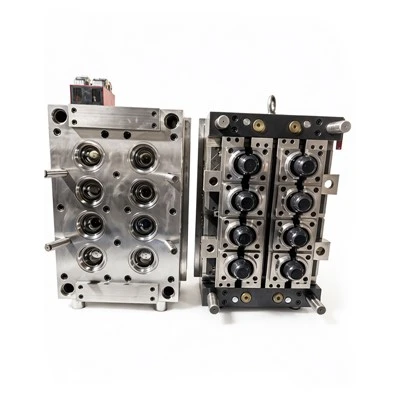
Let’s start with the basics: in PET preform injection molding, the screw’s job is two-fold. First, it melts solid PET resin pellets by pushing them against the heated barrel wall. Second, it builds pressure to force that molten plastic into the preform mold cavity. Screw speed refers to how fast that screw rotates as it does both jobs. It sounds simple, but the relationship between speed and preform quality is counterintuitive, especially because PET is not like other plastics. Unlike polypropylene or HDPE, PET is a hygroscopic resin—meaning it absorbs moisture from the air. If not dried properly before processing, that moisture boils when melted, creating tiny bubbles in the preform that weaken the final bottle. But screw speed affects how much heat the PET is exposed to, and how evenly it mixes, which amplifies (or fixes) drying oversights.
Here’s where most manufacturers miss the mark: they treat screw speed as a single number, but it actually has two distinct phases in preform production: plasticizing speed (the speed at which the screw rotates to melt and convey resin) and injection speed (the speed at which the screw moves forward to shoot molten plastic into the mold). Both impact preforms, but in very different ways. Let’s break down plasticizing first. When you set your plasticizing speed too high, the screw spins so fast that PET pellets get sheared against the barrel wall at a rate that generates excessive friction heat. PET has a very narrow thermal processing window—too little heat and it won’t melt evenly; too much heat (from high shear) causes polymer chain degradation. Degraded PET is brittle, so preforms made this way will crack during blow molding, even if they look fine right off the mold. I saw this with a client last year: they were running 300 RPM on their plasticizing screw, which was degrading the PET enough that their preforms had a 12% blow failure rate. When we adjusted the speed to 180 RPM, failure dropped to 2%. But it’s not just about slow speed—run it too slow, and the screw can’t fully melt the resin, leaving solid pellets in the melt stream. Those pellets cause short shots, or hard spots in the preform that can’t be blown evenly. Our mold designs include small gate features that help mask minor melting inconsistencies, but they can’t fix a screw speed that’s off by more than 20 RPM.
Now, the injection phase: this is when the screw’s forward speed determines how quickly molten plastic fills the mold cavity. Preform molds have a complex design—they have a neck finish (the part that holds the bottle cap), a body, and a gate at the tip. If injection speed is too slow, the molten PET starts to cool as it flows through the mold, especially around the thin neck area. That causes uneven wall thickness: the neck might be too thick, and the body too thin, leading to bottles that bulge when filled or leak at the cap. I worked with a mid-sized beverage company that was getting returns because their bottle necks were misaligned with cap liners. We tracked it back to their injection speed of 100 mm/s—slow enough that PET cooled before filling the neck. Cranking it to 220 mm/s filled the mold so fast that the plastic didn’t have time to cool, resulting in perfect neck alignment. But push injection speed too far, and you get flow marks or air bubbles trapped in the preform. High speed sends molten PET rushing into the mold, which traps air between the plastic and the mold walls, creating voids that weaken the preform. Our molds have venting grooves along the cavity walls that help release that air, but even the best mold can’t overcome excessive injection speed.
The link between screw speed and mold design is something I preach to every new client, because it’s not just the screw alone—it’s how the two work together. Let’s take a preform mold with a hot runner system, which is the standard for high-volume production. Hot runners keep molten plastic in the channels leading to the mold, so you don’t have to re-melt material every cycle. If you pair a high plasticizing screw speed with a hot runner mold, the excessive shear heat from the screw can cause the hot runner’s manifold to overheat, leading to carbon buildup in the channels. That carbon ends up in preforms, causing cosmetic defects or weak spots. We recently updated our hot runner designs with smaller, heat-resistant manifolds that work better with mid-range screw speeds (150–200 RPM) because they dissipate heat more evenly. For manufacturers that run high-volume lines with cold runner molds (cheaper, but less efficient), a slightly faster plasticizing speed (200–220 RPM) is necessary to make sure the resin melts fully before it’s sent to the mold—cold runners don’t keep plastic as warm, so you need a faster screw to get consistent melt quality.
Another often overlooked factor: screw speed impacts cycle time, which directly affects production costs. For preform manufacturers running 24/7, every second counts. When I started in this industry, the average cycle time for a 28g water bottle preform was 28 seconds. Today, with the right screw speed and mold, it’s down to 16 seconds—no loss in quality, just better speed. How? By tuning the plasticizing speed to melt PET in less time without causing degradation, and injection speed that fills the mold fast enough to avoid cooling delays. But if you push the speed too hard, you’ll get more rejects, which eat into those savings. I had a client that tried to cut cycle time by 3 seconds per preform by upping their injection speed, but the number of bad preforms doubled. They ended up saving $2,000 a month in cycle time, but lost $5,000 a month in material waste. The sweet spot is different for every mold, resin, and machine, but as a mold supplier, we’ve standardized our test runs on 170 RPM plasticizing and 200 mm/s injection speed for most standard preform molds—numbers that balance speed and quality.
Let’s talk about material consistency, because screw speed also affects how evenly additives in PET are mixed. Most preforms use colorants, UV stabilizers, or barrier additives for products like soda (which needs to keep CO2 in). If plasticizing speed is too low, these additives don’t disperse evenly, leading to streaky preforms or uneven barrier properties. A client that made preforms for carbonated drinks was having complaints from bottlers that some bottles lost fizz faster than others. We tested their mix: their UV stabilizer was clumped together because their screw was only spinning 120 RPM, too slow to break down the additive pellets. Increasing plasticizing speed to 190 RPM broke up the clumps, and barrier consistency jumped from 88% to 99%. That’s a big difference—bottlers can’t afford to lose product to flat soda, so preform consistency is non-negotiable.
I’ve also seen how screw speed interacts with mold wear. When a screw is running too fast, the high shear between the screw and the barrel causes more wear on both the screw and the mold. Preform molds are made of hardened steel, but repeated exposure to excessive friction from high screw speed can cause scratches on the cavity walls, which show up as lines on the preform, leading to rejects. Over time, that wear shortens mold lifespan by 20–30%, adding thousands of dollars in replacement costs. A client of ours ran their old screw at 350 RPM for two years, and their preform molds needed re-polishing every 6 months. After we adjusted their screw speed to 175 RPM and provided a new, low-shear screw design, their molds only needed re-polishing every 18 months. That’s a huge cost save—mold polishing costs around $1,200 a time, so that’s $2,400 a year per mold. When you’re running 10 molds on a line, that adds up fast.
So, how do you find the right screw speed for your specific preform mold and production line? It’s not a one-size-fits-all number, but here’s the framework we use with every client: first, test your resin. Check its moisture content—if it’s above 0.02%, dry it for 4 hours at 160°C before processing. Then, run a test at 150 RPM plasticizing speed and 180 mm/s injection speed, and check the preforms for melt consistency, wall thickness, and cosmetic defects. If you see solid pellets, increase plasticizing speed by 10 RPM; if you see degradation, decrease it by 10 RPM. For injection speed, if you get short shots, increase it by 20 mm/s; if you get air bubbles, decrease it by 20 mm/s. And always adjust in small increments—PET’s behavior changes fast, so a 50 RPM jump can ruin a whole batch.

If you’re running preform production and dealing with issues like inconsistent preform quality, high reject rates, or mold wear, the right screw speed paired with a tailored preform mold design can solve most of your problems. As a mold supplier, we don’t just sell molds—we work with our clients to tune every part of the production line, including screw speed, to get the best results. Whether you’re a small operation running one machine or a large plant with 20 lines, we can help you test and adjust your setup to cut waste, boost speed, and improve preform quality. If you’re ready to review your current preform production and find the right screw speed for your mold, reach out to us to discuss your needs.
Medical Injection Mold References
- Rosato, D. V., & Rosato, M. G. (2004). Injection Molding Handbook (5th ed.). Kluwer Academic Publishers.
- Speerschneider, C. J., & Li, C. H. (1964). Shear Degradation of Polymers. Journal of Applied Polymer Science.
- Campbell, G. A., & Spotswood, T. M. (1996). Injection Mold Design Engineering. Hanser Publishers.
- Petros, A. J. (2008). PET Packaging: Science and Technology. Wiley-Interscience.
Taizhou Koni Mould Co., Ltd.
As one of the most professional pet preform mold manufacturers and suppliers in China, we also support customized service. Please feel free to wholesale high quality pet preform mold made in China here from our factory. For pricelist, contact us now.
Address: No. 97 Jinju Road, Chengjiang Subdistrict, Huangyan District, Taizhou City, Zhejiang Province
E-mail: kn@kenimould.com
WebSite: https://www.kenimouid.com/
